Be yourself; Everyone else is already taken.
— Oscar Wilde.
This is the first post on my new blog. I’m just getting this new blog going, so stay tuned for more. Subscribe below to get notified when I post new updates.
Be yourself; Everyone else is already taken.
— Oscar Wilde.
This is the first post on my new blog. I’m just getting this new blog going, so stay tuned for more. Subscribe below to get notified when I post new updates.

We have often seen companies having a better handle on store returns, but struggle with respect to online returns. For one of our clients, while store returns remained flat at 4-5%, online returns hovered around 30-35%, going even as high as 40%.
As one of the ways to address this, we developed an algorithm to predict the online return probability, generating a real-time score during online transactions.
This score reflected the propensity of return incidence based on historical trends in transactional attributes and customer demographic parameters.
Called as Returns Propensity Score or RPS, this score was used to implement differential returns policy, sales strategies, return control measures as well as loyalty program refinements.
This multi-variate scoring algorithm was integrated with machine learning capabilities to ensure any shift in customer behaviour is incorporated in future scores.
RPS was also utilised in drafting return policy with proactive measures to curb return frequency, besides refining loyalty programs and streamlining inventory and supply chain management.
About the author:
Ashwin Malik Meshram is the Managing Director for a US-headquartered predictive analytics and artificial intelligence firm Spinnaker Analytics. He has worked closely with CEOs, CMOs and CFOs of leading corporations in North America and Europe, on diverse initiatives ranging from business transformation to machine learning. He is an IIT Bombay alumnus, and currently splits his time between Boston and Mumbai.
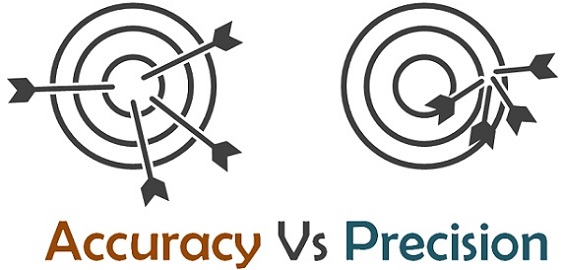
Conversationally, the terms “accuracy” and “precision” are often used interchangeably. Scientifically speaking, however, the terms refer to markedly different conceptual measures. “Accuracy” refers to the proximity of an estimate to the actual value, while “precision” refers to the closeness of individual estimates to each other. For example, throwing darts close to the bullseye would be accurate, while throwing darts very close to each other would be precise even if they’re nowhere near the bullseye!
Companies often make the mistake of utilizing methods that seem powerful by virtue of their precision. At first, declaring that third-quarter sales will hit precisely $496.83M sounds more impressive and compelling than an estimated range of $462M to $465M – that is, until actual sales come in at $463M.
In this case, the precise estimate was precise…ly incorrect! At Spinnaker, we always value accuracy in predictive analytics solutions.
About the author:
Nirav Dagli is the CEO of a predictive analytics and artificial intelligence company based out of Boston, and a former partner at Oliver Wyman. He specializes in financial modelling, algorithm development and predictive analytics with an expertise in banking, insurance, asset management and consumer goods. Other specialties include provision of business engineering support for senior executives in top spanning strategic planning, merger integration and performance improvement. Nirav is also a board member at the Boston Children’s Museum and Better Business Bureau.
This is an example post, originally published as part of Blogging University. Enroll in one of our ten programs, and start your blog right.
You’re going to publish a post today. Don’t worry about how your blog looks. Don’t worry if you haven’t given it a name yet, or you’re feeling overwhelmed. Just click the “New Post” button, and tell us why you’re here.
Why do this?
The post can be short or long, a personal intro to your life or a bloggy mission statement, a manifesto for the future or a simple outline of your the types of things you hope to publish.
To help you get started, here are a few questions:
You’re not locked into any of this; one of the wonderful things about blogs is how they constantly evolve as we learn, grow, and interact with one another — but it’s good to know where and why you started, and articulating your goals may just give you a few other post ideas.
Can’t think how to get started? Just write the first thing that pops into your head. Anne Lamott, author of a book on writing we love, says that you need to give yourself permission to write a “crappy first draft”. Anne makes a great point — just start writing, and worry about editing it later.
When you’re ready to publish, give your post three to five tags that describe your blog’s focus — writing, photography, fiction, parenting, food, cars, movies, sports, whatever. These tags will help others who care about your topics find you in the Reader. Make sure one of the tags is “zerotohero,” so other new bloggers can find you, too.

 Mad Over Data's Blog